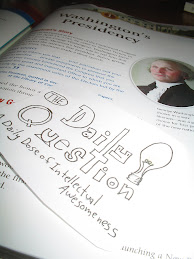
5 sets of presidents share names. I'll go in chronological order-
John Adams was the father of John Quincy Adams. Neither had a very successful presidency in my opinion. Next comes William Henry Harrison and his grandson, Benjamin. Both were elected partially because of their successes in battle, William in the Revolution and Benjamin in the Civil War. Moving right along, we have Andrew Johnson and Lyndon B. Johnson, the only presidents on the list who weren't related. After them the Roosevelts, Theodore and Franklin, whose terms were almost 40 years apart. They were 5th cousins. Finally, we have the George H.W. and George W. Bush, the most recent pair.
Now for today's question. I understand I am notorious for asking periodic table questions, but today is a variation on the subject. You see, back in the old days, the Greeks had their own version of the elements. Substances that could not be broken down anymore than they already were; the most basic parts of earth. And to prove it, all you had to do is burn a tree. So for today, I ask: What were the original Greek elements?
(Please Comment)
Showing posts with label science. Show all posts
Showing posts with label science. Show all posts
Tuesday, July 21, 2009

Tuesday, June 16, 2009
June 16- Science
I hope you are as excited as I am to be returning to the regular daily loop. Today's question is a bit of a cross-over question between science and music, so I did have a bit of turmoil coming down to the decision. As you can most certainly tell, I chose to put it under science. Since it was beautiful today, I decided to sit out on my sun porch and listen to music. And not just normally listening to music on a sissy iPod, I mean listening to music on the phonograph. If you've never listened to music on a record player before, you definitely should some time. Anyway, all this was brought on today when I was looking downstairs in my basement and found a container of jazz records. Well, you can bet I popped those guys in there as soon as I could get up the stairs. And as I watched the record spin tunes from the likes of Prima and Brubeck, I began to wonder how it was actually being brought to me. So for my daily question, I ask: How does a phonograph work?
There is an infinity of informational depth that you could get into on the subject of sound, and no one, me especially, likes hearing complexities that I couldn't care less about. So basically, a record is started with a sound. The sound travels down a tube, and makes a part called the diaphragm vibrate. The diaphragm is connected to a stylus, that then pushes down on the new record, at this point made out of wax. The record is on a platform being spun as the imprints are being made on it. Think of it as the childrens' song about bones: The sound is connected to the, diaphragm. The diaphragm's connected to the, stylus. The stylus is connected to the, record. This process makes a piece of wax with tiny little groves all over it. Now, do it in reverse. When you put the wax on a spinning platform, and let the stylus spin slowly down it, the sound is sent down a diaphragm, and out the horn. Then, a contented jazz enthusiast can obsorb the music.
For more info visit: http://www.pbs.org/weta/roughscience/series2/challenges/sound/page3.html
There is an infinity of informational depth that you could get into on the subject of sound, and no one, me especially, likes hearing complexities that I couldn't care less about. So basically, a record is started with a sound. The sound travels down a tube, and makes a part called the diaphragm vibrate. The diaphragm is connected to a stylus, that then pushes down on the new record, at this point made out of wax. The record is on a platform being spun as the imprints are being made on it. Think of it as the childrens' song about bones: The sound is connected to the, diaphragm. The diaphragm's connected to the, stylus. The stylus is connected to the, record. This process makes a piece of wax with tiny little groves all over it. Now, do it in reverse. When you put the wax on a spinning platform, and let the stylus spin slowly down it, the sound is sent down a diaphragm, and out the horn. Then, a contented jazz enthusiast can obsorb the music.
For more info visit: http://www.pbs.org/weta/roughscience/series2/challenges/sound/page3.html
Tuesday, June 2, 2009
June 2- Science
In 2006, 5% of astronomers worldwide voted on a subject that would be hotly debated until now, and probably for a while to come. What vote could this possibly be? The split decision to degrade Pluto from being a planet to a dwarf planet. How could such an atrocity have taken place? How dare the IAU make such a decision?! It's to small to be a planet anyway...whatever your opinion is, technically, Pluto isn't a planet anymore. So for my daily question, I ask: Why?
The new definition of a planet is a bit more complex than the former definition of a planet. First, a planet must orbit around the sun. Well, lots of things do that. Comets, Asteroids, all that stuff. It needs to have enough gravity to pull itself into a spherical shape. Gravity is a force that surrounds anything with mass. The more mass, the more gravity. If there is enough mass, an object can pull itself into a ball, the tightest object it can become. Pluto can do that. Finally, a planet must clear everything near its orbit. This is where Pluto just doesn't match up. There are lots of thing near Pluto that it just doesn't have enough gravity to pull into it. So, unfortunately for now, Pluto remains a "dwarf planet".
The new definition of a planet is a bit more complex than the former definition of a planet. First, a planet must orbit around the sun. Well, lots of things do that. Comets, Asteroids, all that stuff. It needs to have enough gravity to pull itself into a spherical shape. Gravity is a force that surrounds anything with mass. The more mass, the more gravity. If there is enough mass, an object can pull itself into a ball, the tightest object it can become. Pluto can do that. Finally, a planet must clear everything near its orbit. This is where Pluto just doesn't match up. There are lots of thing near Pluto that it just doesn't have enough gravity to pull into it. So, unfortunately for now, Pluto remains a "dwarf planet".
Tuesday, May 26, 2009
May 26- Science
Hello! Bonjour! Olá! Hallo! Ciao! Γειά σου! I don't know how many people have noticed the little spinning globe at the bottom of The Daily Question main page, but it is a very useful tool I am just utilizing the benefits of. Notice the orange dots scattered throughout? Those show where people have visited my blog. The flashing title is you, and any flashing title that is different from about where you are is someone else looking at the blog simultaneously. The reason I am saying all of this is that I am now proud to announce that we have international viewers! I think I know where the European dot came from, but I have no idea who looked me up in Asia. Who ever you are, thank you for your support in the global uplifting of The Daily Question, and thanks to all of those here in the "States" who read everyday also. It is daily readers whom I know are out there that give me the gumption to post everyday, regardless of the hour. (Let's just forget about Saturday for the moment.) In the spirit of this worldwide connectivity, I am going to ask a question about the Internet, which, after all, makes The Question possible. During the Cold War, the American government launched a boatload of new agencies to help get America ahead of the Russians technology-wise. Information Processing Technology Office was one such branch. (Click the link if you knew as little about IPTO as I did.) Long story short, a guy named Lawrence Roberts started a project to work on a new network (packet switching instead of circuit switching, apparently. Yet another thing I learned more about to write this post.) Anyway, on October 29, 1969-a good date to remember for a completely different reason- a connection was made using packet switching. So, for my daily question, I ask: Which two places was the connection made between?
The connection was made between UCLA and the Standford Research Institute.
The connection was made between UCLA and the Standford Research Institute.
Tuesday, May 19, 2009
May 19- Science
There are many ways to define worst, especially when dealing with hurricanes; How many homes were destroyed, how much it cost insurance companies, the possibilities are endless. So for this question, I won't ask which was the worst hurricane ever, this question will be more specific. The year is 1979. A tropical storm is building up steam in the Pacific Ocean. After it passes over Guam, it gains speed. Eventually, it becomes the "largest and most intense tropical cyclone on record". It also holds the lowest sea-level pressure on record of 870 mbar. (The average is 1013 mbar.) So for my daily question, I ask: What is the name of this tropical cyclone?
The name of the cyclone is "Typhoon Tip".
For more info visit: http://en.wikipedia.org/wiki/Typhoon_Tip
The name of the cyclone is "Typhoon Tip".
For more info visit: http://en.wikipedia.org/wiki/Typhoon_Tip
Tuesday, May 12, 2009
May 12- Science
Although I was very tempted to ask another question about the periodic table, or something of the like, I decided to restrain myself. Instead I will ask a question about biology. Have you ever noticed at the zoo, that without fail, people are attracted to large animals. Just think back into the Reptile Room. How many people gathered around to see the Poison Dart Frogs? (An inaccurately placed amphibian at that, but this is for another day) People were at the elephants, that's where they were! Or the Rhinos, people are always at those pens. So I thought that the Blue Whale was the largest living thing, until I heard it wasn't a couple months ago. So, without further ado, I give, zee daily question: What is the largest organism in existence?
The largest organism is the Aspen Tree. In fact, you could walk in a grove, and all the trees could be the same living thing. The largest exactly was called Pando, and is in Utah.
The largest organism is the Aspen Tree. In fact, you could walk in a grove, and all the trees could be the same living thing. The largest exactly was called Pando, and is in Utah.
Tuesday, May 5, 2009
May 5- Science
Recently, I was looking at the periodic table of the elements (I have a poster of it) and was looking at the pattern. How the lightest elements elements are at the top and the heavy in the middle, and the strip of medium ones on the bottom. One thing I noticed was that on most standard periodic tables, the element Lawrencium (Lr) is ALWAYS on the bottom right. This got me interested... because frankly, Lawrencium is strangely named. It doesn't have a normal name, like Hydrogen or Carbon or Lithium, but at the same time, it isn't clearly named after anything, like Americium; you know what that element was named after. Anyway, this brings me to my question of the day: For whom or what is Lawrencium named after?
First off, it was named after Ernest Lawrence (1901-1958) who invented the machine (cyclotron) that created Lawrencium. Lawrencium itself is Californium bombarded with Boron.
For more info (and to get all the fancy stuff) visit: http://homepage.mac.com/dtrapp/people/Lawrencium.html
First off, it was named after Ernest Lawrence (1901-1958) who invented the machine (cyclotron) that created Lawrencium. Lawrencium itself is Californium bombarded with Boron.
For more info (and to get all the fancy stuff) visit: http://homepage.mac.com/dtrapp/people/Lawrencium.html
Wednesday, April 29, 2009
April 28- Science
You see it all the time in ads. This cleaning product will be so and so effective. And often, non-descriptive words are used, like "cleaner" or "fresher". Notice how they don't often use the words sanitize or sterilize. Well, at least I noticed that. Anyway, they don't use those words because those words have definitions. Which brings me to my question of the day: What is the difference between sanitize and sterilize?
To sanitize something, you need to get rid of 99.999% of micro organisms in 30 seconds. To sterilize something, you need to get rid of every micro organism, in 30 seconds.
To sanitize something, you need to get rid of 99.999% of micro organisms in 30 seconds. To sterilize something, you need to get rid of every micro organism, in 30 seconds.
Tuesday, April 21, 2009
April 21- Science
Radios are weird. They have all sorts of strange properties, like if you grab the antenna, the reception gets better. Another strange thing, that you may or may not have noticed, is that the reception is often times better at night. Which brings me to my question of the day: Why is the reception better at night? (Hint, it has to do with the sky)
In order to find a complete answer, we need to remember a couple of things. First, the earth is constantly revolving. Second, there are several layers of the atmosphere that keep said earth from frying. One such layer is the ionosphere. This is a layer of the atmosphere that has lots of ions very close to each other. Now lets look down at the picture. (Click on it to see the image in its entirety) You can't really see some of the writing I put on there, but, you can see the earth, and that white oval around it. Inside the oval is a purple line. That represents radio waves. Now, the left side of the earth is day, and the right is night. Since the ions are so close in the ionosphere, radio waves have to bounce off them. You can see that the ionosphere is closer during the day, so the radio waves have to bounce more, giving it more opportunity to get blurred. But at night, the ionosphere is farther away, so the waves can go farther in one bounce. This means you get a clearer reception.

In order to find a complete answer, we need to remember a couple of things. First, the earth is constantly revolving. Second, there are several layers of the atmosphere that keep said earth from frying. One such layer is the ionosphere. This is a layer of the atmosphere that has lots of ions very close to each other. Now lets look down at the picture. (Click on it to see the image in its entirety) You can't really see some of the writing I put on there, but, you can see the earth, and that white oval around it. Inside the oval is a purple line. That represents radio waves. Now, the left side of the earth is day, and the right is night. Since the ions are so close in the ionosphere, radio waves have to bounce off them. You can see that the ionosphere is closer during the day, so the radio waves have to bounce more, giving it more opportunity to get blurred. But at night, the ionosphere is farther away, so the waves can go farther in one bounce. This means you get a clearer reception.

Tuesday, April 14, 2009
April 14th-Science
The much loved Ozone layer. High above us, it converts UV rays into heat. Without it, the Earth would become sterilized, or in simpler terms, we'd be toast. Man made pollutants are constantly breaking down this part of the atmosphere, but more recently, the Ozone layer has been patching itself up. But what exactly is the Ozone layer?
The element that makes up the Ozone layer is oxygen. The exact compound is O3 which means that it is 3 oxygens linked together.
To learn more visit:
http://en.wikipedia.org/wiki/Ozone_layer
http://www.nas.nasa.gov/About/Education/Ozone/ozonelayer.html
http://www.oar.noaa.gov/climate/t_ozonelayer.html
The element that makes up the Ozone layer is oxygen. The exact compound is O3 which means that it is 3 oxygens linked together.
To learn more visit:
http://en.wikipedia.org/wiki/Ozone_layer
http://www.nas.nasa.gov/About/Education/Ozone/ozonelayer.html
http://www.oar.noaa.gov/climate/t_ozonelayer.html
Subscribe to:
Posts (Atom)